
Custom acrylic rulers: thickness, scale and finish
The three acrylic ruler builds — 2 mm print, 4 mm bevelled edge, 2 mm plus epoxy — what each one is for, why the scale is a spec rather than artwork, and what to check on the proof.
OFFPRESS editorial · Based on direct observation of real pieces · Stage: Preparing artwork · 31 Oct 2026
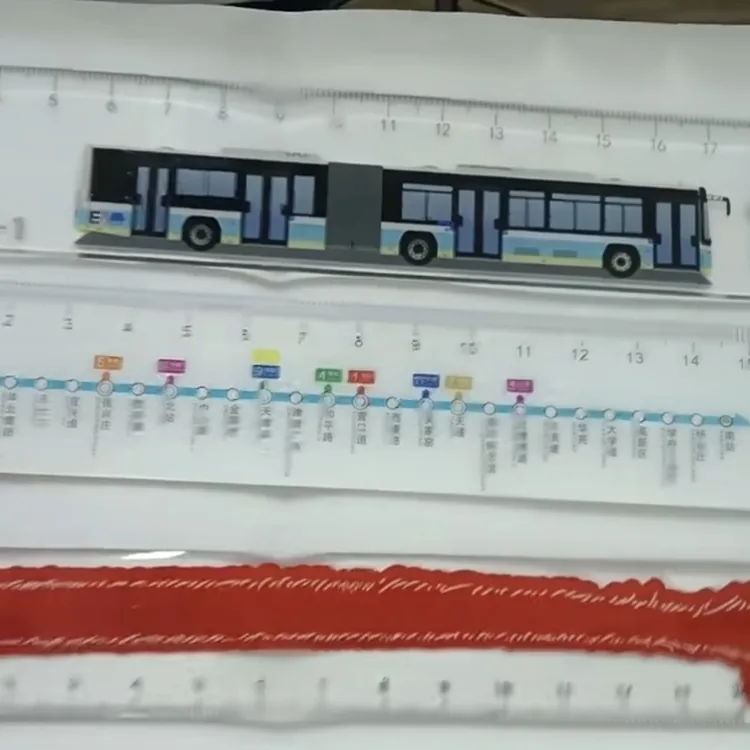
A ruler is ordered as merch and judged as a tool. The artwork is the visible half; the scale, the stock and the edge decide whether anyone keeps it. This page covers the three builds we produce and the checks that prevent a reprint.
1. The three builds
| Build | Stock | What it is for |
|---|---|---|
| Printed | 2 mm | The standard giveaway: light, cheap to ship, one or two print colours |
| Bevelled edge | 4 mm | A stationery object rather than a giveaway — rigid, polished edge, weight in the hand |
| Epoxy dome | 2 mm + dome | A glassy surface on a shaped outline; the dome also stiffens the piece |
The difference is not cosmetic. A 4 mm ruler resists flexing in a bag; a 2 mm ruler with a dome feels like a resin charm. Pick the build from how the ruler will be used, then design into it.
2. The scale is a spec, not artwork
This is where ruler jobs fail. A ruler that measures 99 mm to the 100 mm mark is a reject, however good the print looks.
- Check the proof at 1:1. Print it, put a real ruler on it, and compare every major mark. Screen mockups lie about scale — this is the same lesson as checking artwork at actual size, with a harder pass/fail line.
- Decide the scale direction. Metric is the standard we quote. Imperial or dual scales are set on your proof, not assumed from the artwork file.
- Keep the marks off the artwork. The scale needs a clear band along one edge; illustration and text that run into it make the tool hard to read.
3. Straight or shaped
Straight strips cut cleanly and ship flat — the default for promo and school work. Shaped outlines (a mascot, a cat, a logo) are die-cut on 2 mm stock; the parts to watch are thin tails, whiskers and narrow gaps, which get thickened before cutting. The shaped build also takes the epoxy dome well, because the dome stiffens the outline.
4. Lengths and where they sell
- 15 cm — the standard promotional length: pocket-sized, cheap to ship, enough scale to be usable.
- 20 cm — the stationery length: reads as an object, pairs with notepads and bookmarks in a set.
- Other lengths — quoted; the scale layout has to be redrawn for the new length, so it is a new proof, not a stretch.
5. What to send with a ruler enquiry
- The artwork at final size, with the scale band marked.
- The length and the build (2 mm, 4 mm bevelled, or 2 mm plus dome).
- Whether the outline is straight or shaped — and the cut line if it is shaped.
- The quantity, even a ball-park; the quote is built on the real number.
The acrylic rulers page carries the published specs and the configurator. If the ruler is part of a stationery set, say so — the same artwork usually needs a different layout for a pad or a bookmark.
Researched and written by the OFFPRESS editorial desk. General production principles are kept separate from order-specific figures — anything that depends on your job (lead time, sample cost, freight) is marked as confirmed with your quote, not stated as a blanket promise.
RELATED PRODUCTS
Acrylic Rulers
Printed acrylic rulers — 15 cm and 20 cm, in 2 mm stock, 4 mm bevelled stock or 2 mm under an epoxy dome.
KEEP READING