
Foldable phone custom case guide: construction, artwork, and RFQ
What changes when you commission custom cases for foldable phones: shell splits, hinge clearance, split artwork, magnet position, and the RFQ fields to send a factory.
OFFPRESS editorial · Researched against external sources · Stage: Comparing suppliers · 23 Sept 2026
If you already buy custom cases for bar phones, do not assume the same RFQ works for a foldable. The device opens, the shell may be split, and artwork may cross a fold.
This guide is for creators, small brands, and sourcing contacts who need to brief a factory on foldable geometry before tooling or print.
The buyer problem:
What changes when commissioning a custom case for a foldable phone instead of a conventional slab phone?
1. Why foldable cases differ from slab cases
| Slab phone (typical) | Foldable phone (typical) |
|---|---|
| One continuous shell | Shell may be two-piece or include a flex bridge — confirm with your supplier |
| One print face | Print may need split / register across shells |
| Fixed thickness | Thickness changes folded vs open (device-dependent) |
| Camera island on one face | Often outer + inner cameras; outer screen can act as a second face |
| Hinge is rarely a case constraint | Hinge clearance is a case constraint |
A generic phone-case template can misalign cutouts, bind at the fold, or strand artwork across a hinge gap.
2. Construction variables to confirm with the supplier
Treat these as RFQ variables, not settled engineering facts. Names and methods vary by factory.
| Variable | Ask the supplier to state |
|---|---|
| Shell split | One piece, front + back, or skin/wrap only |
| Flex / hinge cover | Separate part, integral bridge, or open spine |
| Join method | Clip, adhesive, rail, or other — request a drawing |
| Print faces | Which faces receive print (outer front, outer back, spine, inner rim) |
| Lip height | How far the lip rises above glass / camera rings |
| Port & button access | USB-C, mics, speakers, side button |
| Strap / charm hole | Diameter and position — keep clear of hinge and thin walls |
Avoid copying a competitor teardown as a production spec. Ask for per-face drawings or a 3D envelope.
3. Hinge clearance
Decision rules (there is no universal millimetre standard):
- The case should open and close through the full intended range of motion without bind, lift, or scrape. Treat this as a procurement requirement in the sample checklist.
- Agree a no-print / no-decor zone across any flex or hinge wrap so ink and film are less likely to crack at the fold. Exact zone size is supplier-defined.
- Hinge dimensions from photos are not reliable. Request a hinge envelope (width × height × depth in open and closed states) from the factory or OEM drawings.
Validation: run repeated sample open/close testing on a physical sample before bulk. Stop if the shell creaks, lifts, or marks the spine. A mock-up image is not a fit test.
4. Outer-display and camera clearance
Foldables can add a second display and more camera furniture.
| Clearance | Ask in RFQ |
|---|---|
| Outer display opening | Size and corner radius; the opening should not intrude into the active display area (treat safe inset as a supplier/OEM figure) |
| Rear camera island | Cutout vs open face; lens ring vs case lip |
| Outer front camera / sensors | Measure on the device drawing for that model |
| Inner screen | Avoid inner-rim oversize that rubs the display; under-display cameras may need no cutout |
If a factory only asks for length and width, they may still be treating the device as a slab. Request per-face drawings.
5. Artwork across shells
| Issue | Practice |
|---|---|
| Split | Decide what is on shell A vs shell B vs spine before layout |
| Alignment | Use the supplier production template and alignment references they provide. There is no universal registration-mark rule |
| Bleed at fold | Follow the supplier’s safe line at flex/hinge |
| No-print areas | Hinge wrap, clip recesses, camera rings — keep type and critical faces out if the process requires it |
| Edge printing | Often a different fixture; confirm whether face print can continue over the edge |
For general file prep, see check artwork at actual size and cut lines, bleed, safe area. Foldables add split and registration questions on top of those.
White ink (conditional): some print stacks use a white underbase so colour reads on clear or dark stock — see white ink on clear acrylic for the principle only. Phone-case substrates and processes differ from acrylic keychains. Confirm white-underbase applicability, substrate, and process with the case supplier.
6. Fit tolerance and sample-on-device
| State | What to check on sample |
|---|---|
| Closed | Thickness stack; pocket fit; button alignment; camera lip |
| Open | Flatness; inner rim bite; no screen rub |
| Open / close cycling | Hinge clearance; shell creep; print behaviour at the spine |
Tolerance language for RFQ (numeric values are factory-supplied — leave blanks until they answer):
- Shell inner cavity vs device drawing: ± ___ mm
- Print-to-cut registration: ± ___ mm
- Lip height above glass: ___ mm
Procurement rule: publish or accept a tolerance only when it is in writing from the factory. Plan a physical sample-on-device before bulk when fit matters.
7. Magnet / MagSafe positioning (where applicable)
Some foldables support magnetic charging. iPhone Duo (example instance) lists MagSafe wireless charging up to 25W, Qi2 up to 25W, a magnet array, an alignment magnet, Accessory Identification NFC, and a magnetometer (Apple, iPhone Duo Tech Specs, 2026-09).
| Topic | Rule |
|---|---|
| Magnet location | Follow the OEM magnet map for that model when available |
| Fold / flex | Agree with the supplier where magnets may sit relative to hinge and flex parts |
| Claim language | Write “magnet ring aligned to [device] MagSafe/Qi2 map (OEM)” only if you have that map. Otherwise treat as unknown |
Third-party case magnet patterns are not an OEM spec. Label third-party sources if you cite them.
8. Print area, edge printing, strap hole
| Feature | Foldable constraint |
|---|---|
| Face print | May split across shells; respect agreed no-print zones |
| Edge print | Confirm fixture capability; watch stress near the spine |
| Strap hole | Keep clear of hinge, thin walls, and magnet ring; specify diameter and reinforcement |
| White underbase | Only if the case process supports it (see §5) |
9. Instance box — iPhone Duo
Device facts (Apple iPhone Duo Technical Specifications, accessed 2026-09-23):
| Open | Closed | |
|---|---|---|
| W×H×D | 164.6 × 117.8 × 5.2 mm | 84.1 × 117.8 × 11.3 mm |
| Weight | 254 g | 254 g |
- Titanium foldable design; Ceramic Shield 2 front and back
- Inner 7.6″ folding OLED · Outer 5.4″ OLED
- Cameras: outer 48MP Dual Fusion system + outer 12MP front camera; inner under-display FaceTime camera
- MagSafe up to 25W · Qi2 up to 25W · magnet array · alignment magnet · Accessory Identification NFC · magnetometer
- USB-C · Touch ID in side button · IP68
This box does not claim case tooling, hinge mechanism details, magnet coordinates, or print process. Those remain supplier and OEM-drawing questions. Update this box when the next foldable ships; the rest of the guide stays as-is.
10. RFQ checklist (copy-paste)
Device: [make / model / generation]
Construction: [supplier to propose: one-piece / two-piece / flex / skin]
Print faces: [front / back / spine / none]
Artwork state: [split files / one wrap / need template]
Hinge envelope: attach drawing or request from us
Outer display / camera cutouts: attach drawing — opening should not cover active display
Magnets: yes/no — OEM map attached? yes/no
Strap hole: diameter __ mm at [location]
Quantity range: [sample / 50 / 200 / 1000+]
Need physical sample-on-device before bulk: YES
11. What OFFPRESS can quote vs sample-dependent
| Topic | Status |
|---|---|
| Printed merch for creators (charms, stickers, magnets, etc.) | See product pages |
| Foldable phone cases | Tooling, MOQ, unit price, lead time: unknown / quote-specific |
| Hinge construction (pin / film / multi-link) | Supplier fact — not asserted here |
| MagSafe-compatible for a given model | Only with OEM magnet map + sample test |
Process education on this page is not a production guarantee.
Next step: send device model, quantity range, artwork approach (split or full wrap), and magnet / strap requirements for a quote and sample plan.
Related: what to send for an accurate quote · check artwork at actual size · phone case models and artwork (slab phones) · white ink on clear acrylic · cut lines, bleed, safe area
Sources and limits
- Apple. iPhone Duo Technical Specifications (
apple.com/iphone-duo/specs) — dimensions, displays, cameras, MagSafe/Qi2 and magnet array, USB-C, Touch ID, IP68. Accessed 2026-09-23. - Construction and join-method language is RFQ vocabulary for briefing a factory, not a published manufacturing standard. Hinge mechanics stay unknown without a supplier drawing you control.
- Accessory-brand leaks (for example Casetify) are demand signals only — not production specs.
Researched and written by the OFFPRESS editorial desk. General production principles are kept separate from order-specific figures — anything that depends on your job (lead time, sample cost, freight) is marked as confirmed with your quote, not stated as a blanket promise.
SOURCES & FURTHER READING
RELATED PRODUCTS
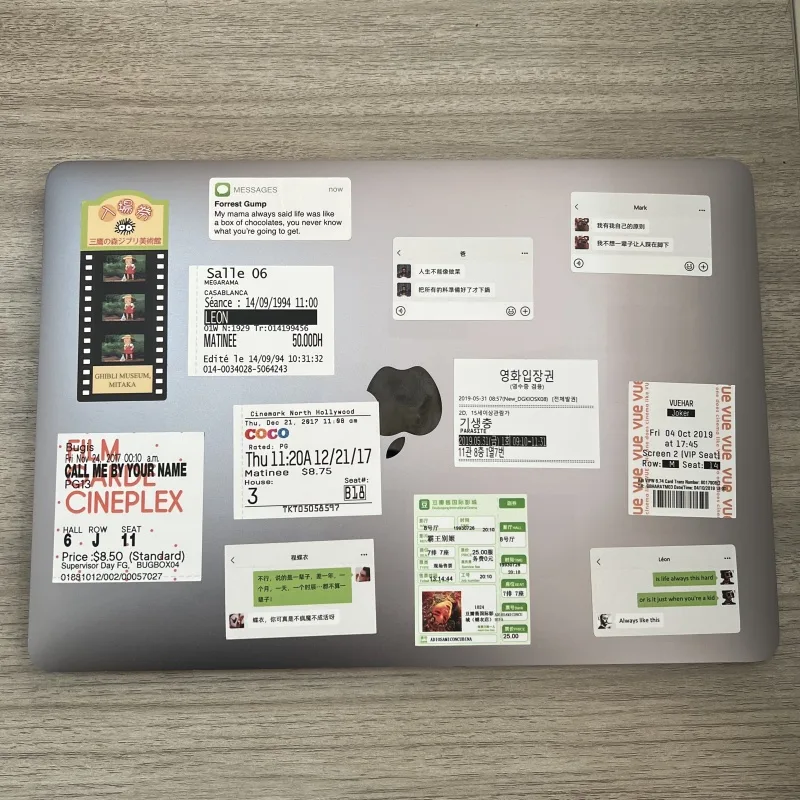
Stickers
Die-cut to your outline or kiss-cut on a sheet. Gloss, matte, holographic or clear.
KEEP READING