
Mouse pad or desk mat? Sizing a custom printed pad
One product family at two scales. How the size decision changes what the pad is for, who buys it, and what your artwork file has to survive — decided before the artwork, not after.
OFFPRESS editorial · Based on direct observation of real pieces · Stage: Preparing artwork · 6 Sept 2026
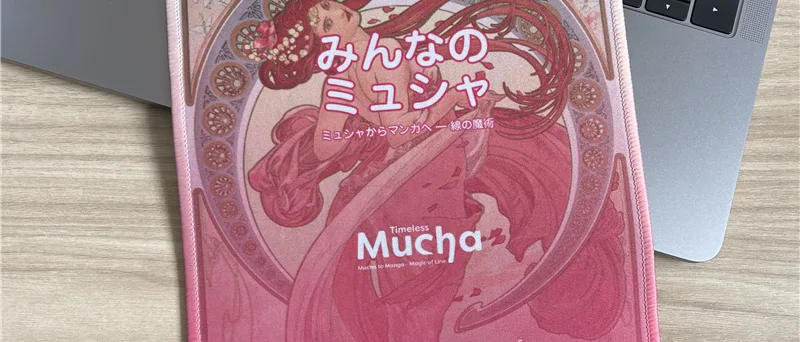
“Mouse pad or desk mat?” is the first decision on a custom pad order, and it’s a size decision disguised as a naming question. The same production line usually makes both: a mouse pad covers the mouse and some wrist room; a desk mat covers the keyboard and mouse — or most of the desk. Size decides the pad’s job, who buys it, where it sits in a merch line, and what your artwork file has to survive. Decide it before the artwork, because the artwork brief is different at each scale. Both formats are part of our made-to-order range — sizes, base and edge options are confirmed with your quote rather than listed as fixed specs.
Two scales, two different products
Supplier conventions put ordinary mouse pads from roughly 320 × 270 mm up to about 490 × 420 mm, and desk mats from about 800 × 300 mm up to 1200 × 600 mm — one gaming-gear maker’s published chart, but the pattern holds across the industry (a pad-goods supplier lists its flat mats at 80 × 30 up to 100 × 50 cm). Your supplier’s actual size ladder gets confirmed in the quote.
The decision the sizes point at:
| Mouse pad | Desk mat | |
|---|---|---|
| Covers | The mouse, plus wrist room | Keyboard and mouse, or the whole desk |
| Lives as | An accessory on the desk | Desk furniture — a backdrop you work on every day |
| Artwork reads at | Hand distance, touched and picked up | Working distance, glanced at daily |
| Design that works | One focal artwork, icon logic | Compositions with zones — large shapes first, fine print as a discovery layer |
| Place in a merch line | Add-on / impulse tier | Statement / premium tier |
| File reality | A modest canvas at print resolution | A very large canvas — the next section |
Neither scale is “better merch.” They sell to the same person differently: the mouse pad is the low-commitment version of your artwork on a desk; the desk mat is the version that redecorates the desk.
The one format that makes your artwork bigger
Every other merch format punishes you by shrinking artwork — detail that survives on screen dies on a 50 mm charm. The desk mat runs the other direction, and it punishes a different mistake: designing small and scaling up.
The arithmetic is unforgiving. At the 300 dpi print resolution pad suppliers typically ask for, a 900 × 400 mm mat needs a file around 10,600 × 4,700 pixels — and one pad supplier adds that the artwork should arrive larger than the final size again, so the edges wrap the cut. Most illustration files are a third of that on a good day. Enlarging a small raster file upscaling-style doesn’t restore the missing detail; it just spreads it thinner — which is why print-on-demand guides warn that resolution numbers mean nothing if the source image itself is thin.
Three honest ways out:
- Draw it at scale. Set up the artboard at the real mat dimensions and design there — the only approach that never fights the format.
- Go vector. Line art and flat shapes re-scale cleanly; painterly texture doesn’t (vector vs raster).
- Use poster logic. Let large shapes carry the mat from across the room, and place fine detail — ticket layouts, timetables, captions — as a layer that rewards close looking. The full-print exhibition mats in our product photos work exactly this way: readable as posters from a metre, discoverable as print pieces up close.
The actual-size test is worth running here too — just inverted: instead of holding a printout close, step back to working distance and ask what still reads.
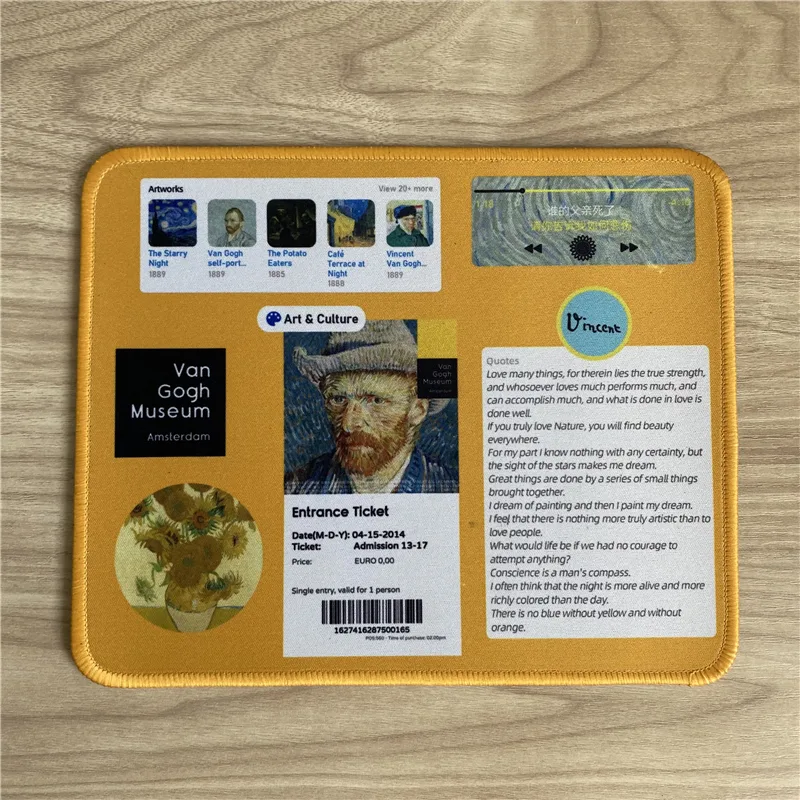
Design for furniture, not for a frame
Here’s the part nobody’s template mentions: a desk mat is the only merch canvas that furniture permanently sits on. The keyboard covers the middle. The mouse roams. A mug parks on a corner. Whatever you put centre-frame may be visible for exactly none of the working day.
The pads in our own photos make the point visibly — one shot has the mouse parked right on top of the print:
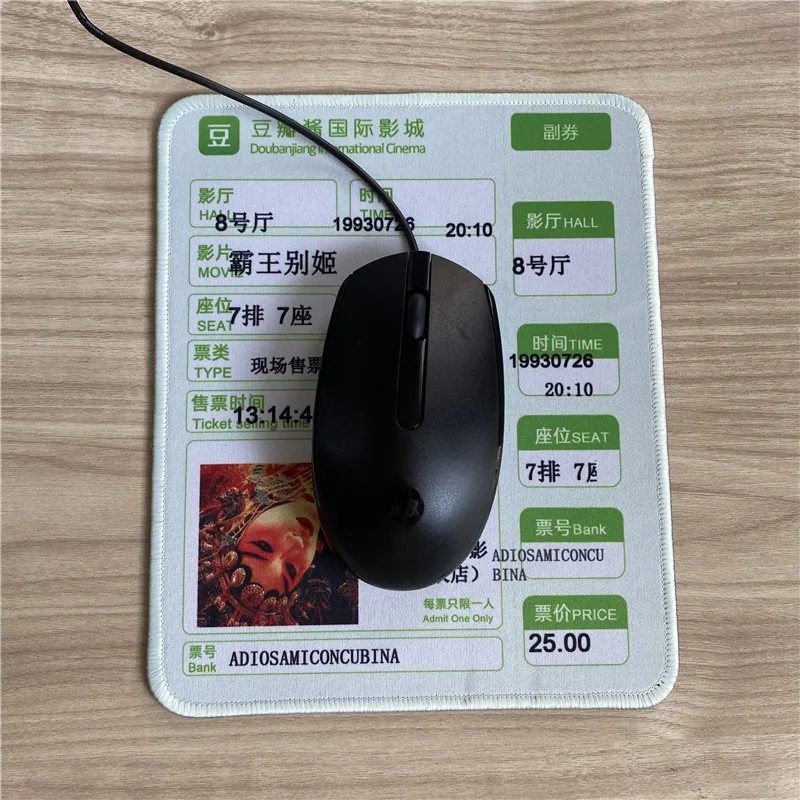
So compose for occlusion:
- The front edge strip and the corners stay visible — that’s where the elements that must be seen belong.
- Dense fine print works best in zones that the keyboard doesn’t cover, where it reads as a discovery rather than a message.
- Big central compositions still work — as texture and tone under the gear, not as the carrier of your only punchline. If the middle matters, the mouse pad scale, where nothing covers the print, is the honest format.
The construction details worth putting in the brief
- Edge: stitched or raw-cut. Stitching is the standard on quality pads; at least one mat maker states plainly that raw-cut mat edges can fray within months of desk life. Stitch thread colour is a spec of its own — buyers who care about a matched edge ask for it explicitly, because black-by-default thread on a pale print is noticeable at this size.
- Base and grip. The base decides whether the mat stays put under daily mouse travel. “It slides on my desk” is the complaint that outlives every beautiful print.
- Thickness and surface weave. They change both the mouse feel and how fine print reads on the fabric surface. These are supply-chain specifics — a supplier’s sample tells you more than their spec sheet.
For our part: mouse pads and desk mats are a format we make to order, and we deliberately don’t publish fixed sizes, base types or edge options — they’re written into your quote per job, where the coverage question above (“which gear must fit?”) gets answered against a real size ladder.
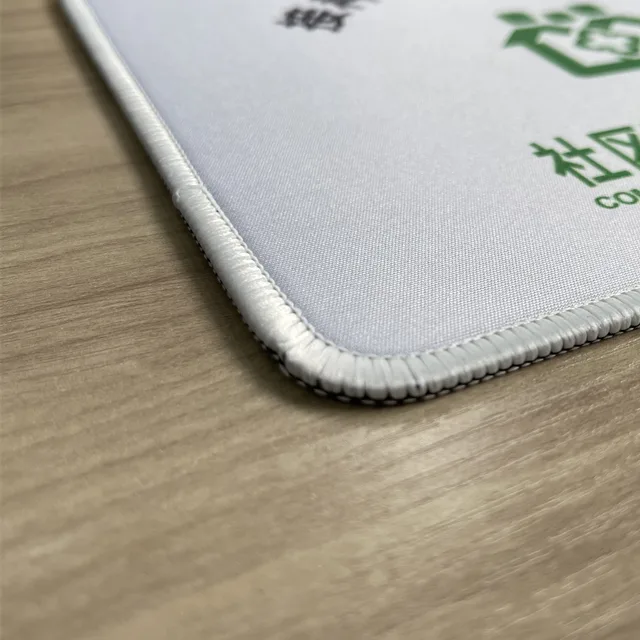
One line in the brief — “desk mat, keyboard and mouse must fit, stitched edge, artwork attached” — is enough for a written quote that comes back with sizes, base and edge options you can hold against any other supplier.
Researched and written by the OFFPRESS editorial desk. General production principles are kept separate from order-specific figures — anything that depends on your job (lead time, sample cost, freight) is marked as confirmed with your quote, not stated as a blanket promise.
KEEP READING